Pioneer in Offering CRM Solutions since 2010...
Pioneer in Offering CRM Solutions since 2010...
 ChatGPT Development
 Claude AI Development
 Gemini AI Development
 Microsoft Copilot Development
 DeepSeek AI Development
 LangChain Development
 CrewAI Development
 AutoGen Development
 LangGraph Development
 Pinecone Development
 Weaviate Development
 AI Workflow Automation
 Qdrant Development
 Cursor AI Consulting
 GitHub Copilot Consulting
 Enterprise AI Search
ChatGPT Development
Claude AI Development
Gemini AI Development
Microsoft Copilot Development
DeepSeek AI Development
LangChain Development
CrewAI Development
AutoGen Development
LangGraph Development
Pinecone Development
Weaviate Development
AI Workflow Automation
Qdrant Development
Cursor AI Consulting
GitHub Copilot Consulting
Enterprise AI Search
Customer communication is no longer limited to phone calls and email. Businesses now interact with customers across WhatsApp, SMS, social media, email, live chat and voice.
The challenge is bringing all these conversations together while maintaining context, speed and a consistent customer experience.
Variance InfoTech designed and developed UCaaS, a multi-tenant, AI-powered omnichannel customer engagement platform that unifies communication, CRM, ticketing, automation and AI in a single workspace.
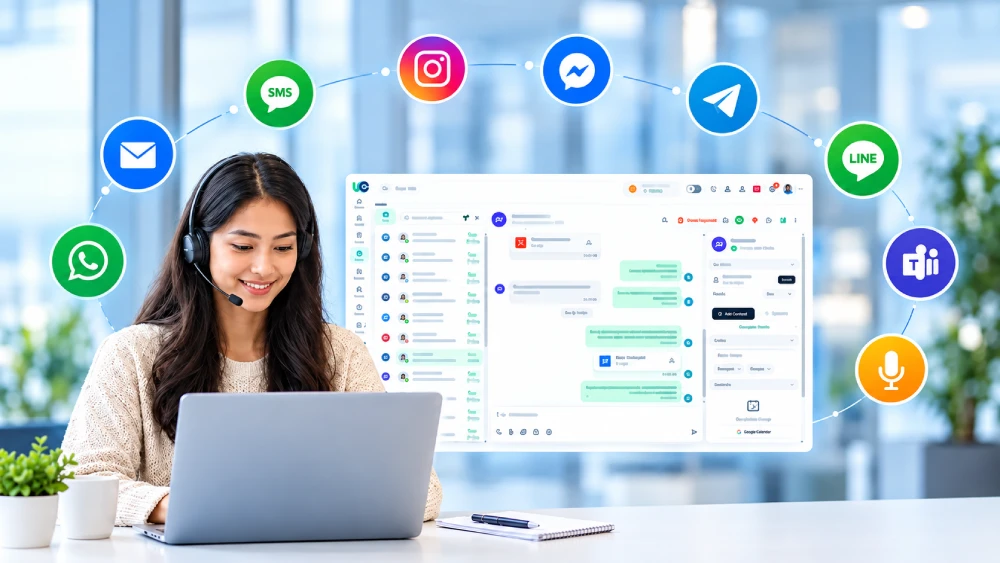
Bring WhatsApp, email, SMS, social, live chat, and voice channels together for seamless customer communication.
Businesses were increasingly managing customer conversations across multiple disconnected platforms.

The multi-touchpoint customer journey across fragmented touchpoints:
Without a unified system, agents often had to switch between applications and manually reconstruct customer history.
Operational bottlenecks and visibility hurdles faced by enterprises:
The goal was to create a platform where teams could manage the entire customer conversation from a single workspace.
Building an omnichannel platform is significantly more complex than building a conventional CRM.
Fragmented protocol standards across third-party communication services:

Experience in CRM, customer experience, communications and SaaS platforms.
A cloud-native architecture designed for multi-tenancy, real-time communication and background processing.
AI integrated throughout the development lifecycle to increase engineering productivity.
AI became part of the Variance development workflow rather than being limited to the product itself.
AI helped engineers break large requirements into:
AI-assisted coding helped accelerate repetitive development activities such as:
AI was used to help generate:
AI assisted developers in analyzing:
As the platform grew, AI helped engineers identify repetitive code and accelerate:
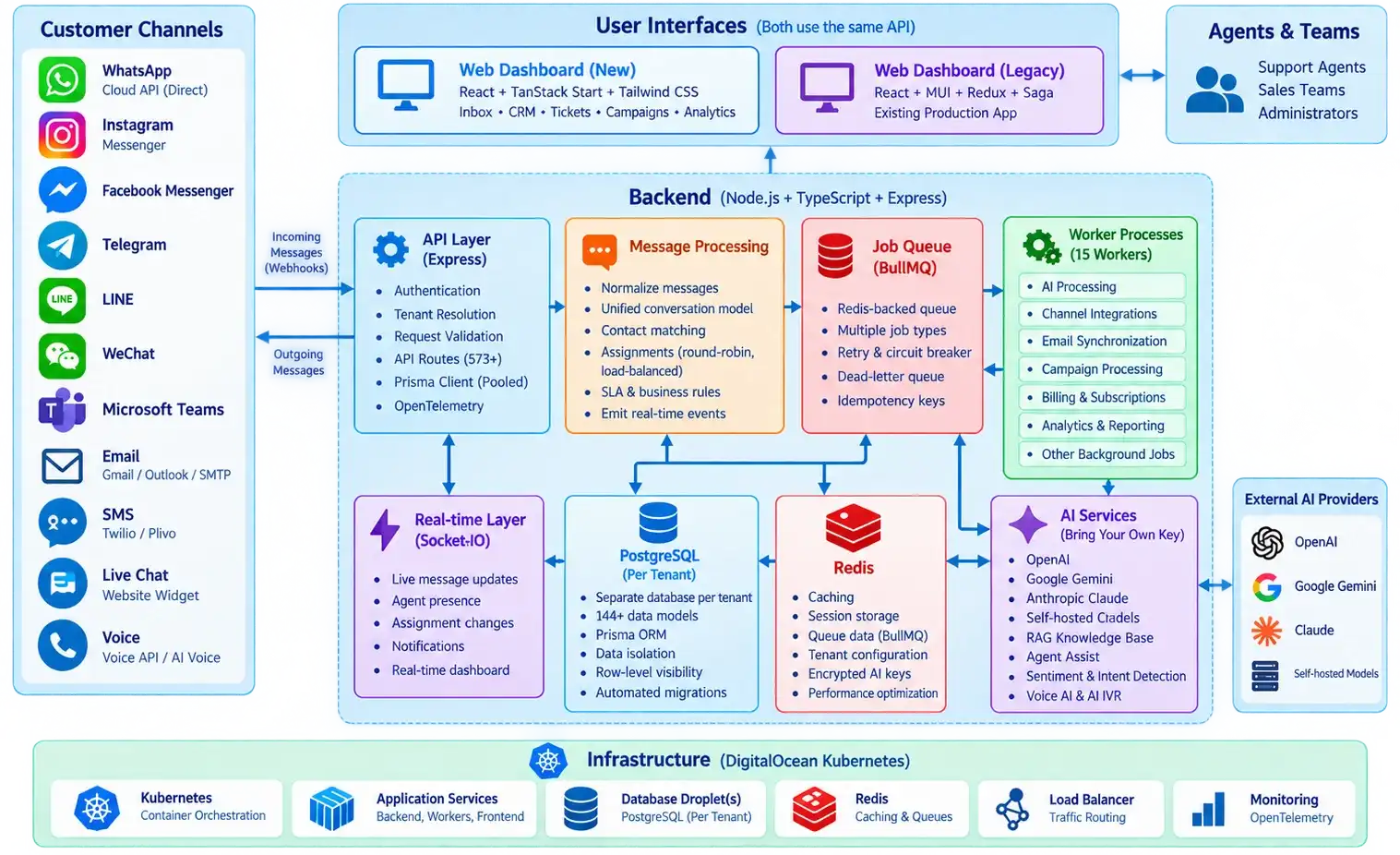
UCaaS was designed around a common conversation and contact model. The platform integrates:
Automated customer conversations for defined use cases.
AI can use business-specific knowledge to generate more relevant responses.
AI helps human agents during conversations.
The platform can identify customer sentiment.
AI can identify the purpose of customer interactions.
AI-powered voice interaction capabilities.
Natural-language AI-driven IVR experiences.
AI can become part of automated business processes.



























After approximately 19 months of development and continuous product evolution:
The biggest impact of AI was not simply producing more code. It was reducing the time spent on repetitive engineering activities.
AI helped accelerate the cycle:
This allowed engineers to focus more heavily on:
AI can significantly increase the productivity of experienced developers when integrated into the development process.
AI can accelerate implementation, but scalable SaaS architecture requires experienced engineering judgment.
A common conversation model is essential when integrating multiple communication providers.
Background processing should not interfere with customer-facing communication.
The faster a team can transform customer requirements into production features, the faster a SaaS product can respond to the market.







Our sales manager reaches out to you within a few days after analyzing your business requirements.
Meanwhile, we sign an NDA to ensure the highest level of privacy.
Our pre-sale manager presents project estimates and an approximate timeline.


 AI Consulting Services
 RAG Development
 LLM Development
 AI App Development
 AI Software Development
 AI Integration Services
 AI Agent Development
 AI Chatbot Development
 LLM Fine-Tuning
 Generative AI Integration
 AI Copilot Development
 Data Analytics
 Data Warehousing
 Data Annotation
 AIOps
 DevOps Consulting
 DevOps Automation
 SRE
 LLM Observability
 AI for Healthcare
 AI for CRM
 AI for Customer Support
 AI for Manufacturing
 AI for Real Estate
 AI for Education
 AI for Finance
 AI for E-Commerce
 AI/ML Consulting
 Object Detection
 ChatBot Development
 Computer Vision
 Natural Language Processing
 Data and Ai
 Mobile Apps Development
 Chrome Extension Development
 Odoo Development Services
 Odoo Implementation Services
 Odoo Customization Services
 Odoo Integration Services
 Odoo Migration & Upgrade Services
 Odoo ERP Consulting Services
 Odoo Support and Maintenance Services
 Odoo AI & Automation Services
 Salesforce Consulting
 Salesforce Product
 Salesforce Case Study
 SuiteCRM Consulting
 SuiteCRM Addons
 Devops
 AWS Consulting
 Digital Ocean Consulting
 OnPrem. Server Support
 Cloud Migration Services
 Salesforce WhatsApp Business API
 Salesforce WhatsApp Web Integration
 Salesforce Telephony Integration
 Dentrix To GHL
 Outlook Integration
 MindBody Integration
 Zillow Integration
 Open Dental To GHL
 Number Plate Recognition
 Taxi App & Mobility
 Smart Bus & Fleet System
 HR Solutions (Salesforce)
 Quick HRMS (SuiteCRM)
 CRM For Telecom Industry
 CRM For Travel
 CRM For Call Center
 CRM For Education
 CRM For Healthcare
 CRM For Clinics
 CRM For Locksmith
 CRM For Law
 NodeJS
 Python
 .NET
 Classic ASP
 Core PHP
 ReactJS
 AngularJs
 Android
 iOS
 Flutter
 React Native
 AR/VR
 CodeIgniter
 Laravel
 Hire .NET Core Developer
 Hire Salesforce Developer
 Hire Odoo Developers
 CRM For Legal Practice
 Online Photo Booking System
 Task Scheduler for Construction Industry
 Patient Management Software
 Dentist Management System
 Food Delivery App
 CRM For Aviation Company
 Salesforce Marketing Cloud for Online Retail Store
 Salesforce Implementation & Customization For RFID Supplier
 Ecommerce System Integration With ERP
 CRM For Real Estate Company
 Find Nearby Salon
 Taxi Booking App
 CRM For Travel Agency
 Case Management Software
 Engineering Company Website
 CRM For Telecom Industry
 Company Profile
 SuiteCRM Profile
 Telco CRM white paper
 AI enabled speech analysis