AI Consulting Services
 RAG Development
 LLM Development
 AI App Development
 AI Software Development
 AI Integration Services
 AI Agent Development
 AI Chatbot Development
 LLM Fine-Tuning
 Generative AI Integration
 AI Copilot Development
 Data Analytics
 Data Warehousing
 Data Annotation
 AIOps
AIOps
 DevOps Consulting
 DevOps Automation
 SRE
SRE
 LLM Observability
 AI for Healthcare
 AI for CRM
 AI for Customer Support
 AI for Manufacturing
 AI for Real Estate
 AI for Education
 AI for Finance
 AI for E-Commerce
 AI/ML Consulting
 Object Detection
 ChatBot Development
 Computer Vision
 Natural Language Processing
 Data and Ai
 Mobile Apps Development
 Chrome Extension Development
 Odoo Development Services
 Odoo Implementation Services
 Odoo Customization Services
 Odoo Integration Services
 Odoo Migration & Upgrade Services
 Odoo ERP Consulting Services
 Odoo Support and Maintenance Services
 Odoo AI & Automation Services
 Salesforce Consulting
 Salesforce Product
 Salesforce Case Study
 SuiteCRM Consulting
 SuiteCRM Addons
 Devops
 AWS Consulting
 Digital Ocean Consulting
 OnPrem. Server Support
 Cloud Migration Services
 Salesforce WhatsApp Business API
 Salesforce WhatsApp Web Integration
 Salesforce Telephony Integration
 Dentrix To GHL
 Outlook Integration
 MindBody Integration
 Zillow Integration
 Open Dental To GHL
 Number Plate Recognition
 Taxi App & Mobility
 Smart Bus & Fleet System
 HR Solutions (Salesforce)
 Quick HRMS (SuiteCRM)
 CRM For Telecom Industry
 CRM For Travel
 CRM For Call Center
 CRM For Education
 CRM For Healthcare
 CRM For Clinics
 CRM For Locksmith
 CRM For Law
 NodeJS
 Python
 .NET
.NET
 Classic ASP
 Core PHP
 ReactJS
 AngularJs
 Android
 iOS
iOS
 Flutter
 React Native
 AR/VR
AR/VR
 CodeIgniter
 Laravel
 Hire .NET Core Developer
 Hire Salesforce Developer
 Hire Odoo Developers
 CRM For Legal Practice
 Online Photo Booking System
 Task Scheduler for Construction Industry
 Patient Management Software
 Dentist Management System
 Food Delivery App
 CRM For Aviation Company
 Salesforce Marketing Cloud for Online Retail Store
 Salesforce Implementation & Customization For RFID Supplier
 Ecommerce System Integration With ERP
 CRM For Real Estate Company
 Find Nearby Salon
 Taxi Booking App
 CRM For Travel Agency
 Case Management Software
 Engineering Company Website
 CRM For Telecom Industry
 Company Profile
 SuiteCRM Profile
 Telco CRM white paper
 AI enabled speech analysis
Discovery
Understand your business, users, information sources, search challenges, and AI objectives.
Pioneer in Offering CRM Solutions since 2010...
 ChatGPT Development
 Claude AI Development
 Gemini AI Development
 Microsoft Copilot Development
 DeepSeek AI Development
 LangChain Development
 CrewAI Development
 AutoGen Development
 LangGraph Development
 Pinecone Development
 Weaviate Development
 AI Workflow Automation
 Qdrant Development
 Cursor AI Consulting
 GitHub Copilot Consulting
 Enterprise AI Search
ChatGPT Development
Claude AI Development
Gemini AI Development
Microsoft Copilot Development
DeepSeek AI Development
LangChain Development
CrewAI Development
AutoGen Development
LangGraph Development
Pinecone Development
Weaviate Development
AI Workflow Automation
Qdrant Development
Cursor AI Consulting
GitHub Copilot Consulting
Enterprise AI Search
Enterprise AI Search
ChatGPT Development
Claude AI Development
Gemini AI Development
Microsoft Copilot Development
DeepSeek AI Development
LangChain Development
CrewAI Development
AutoGen Development
LangGraph Development
Pinecone Development
Weaviate Development
AI Workflow Automation
Qdrant Development
Cursor AI Consulting
GitHub Copilot Consulting
Enterprise AI Search

Discover how enterprise AI search helps businesses find information faster, connect scattered data, improve knowledge access, and support smarter, more efficient decisions.
Business knowledge often lives across multiple applications, departments, databases, and document repositories.
PDFs, emails, documents, presentations, knowledge articles, and other content can be difficult to search efficiently.
Employees may know what they want but not the exact keywords used in the source document.
Employees can spend valuable working time locating information instead of acting on it.
Multiple versions of documents and content can make it harder to identify the most relevant source.
Important organizational knowledge can remain hidden inside disconnected systems.
As organizations adopt AI assistants and agents, they need reliable access to enterprise knowledge.
Enterprise search must respect user permissions and access controls when retrieving organizational information.
We combine enterprise search, AI, data engineering, RAG, and secure integrations to create search experiences around your business.
Sources can include: Documents, CRM, ERP, SharePoint, Intranets, Knowledge bases, Databases, Cloud storage, SaaS applications.
Create secure connections between your search platform and approved enterprise data sources.
Clean, structure, classify, chunk, enrich, and index content to make it easier for AI systems to retrieve.
Combine appropriate search methods: Keyword search, Semantic search, Vector search, Hybrid search, Metadata filtering, Relevance ranking.
RAG is specifically designed to ground LLM responses in external or proprietary information rather than relying only on model training data.
Ensure search results and AI-generated answers respect appropriate user permissions and organizational policies.
Monitor: Search relevance, Query success, User engagement, Response quality, Search latency, AI usage, Cost, Feedback.
Connect enterprise search with everyday applications, workflows, and productivity tools for easier access to information.
Continuously monitor search quality, data access, AI responses, and system performance to maintain reliable enterprise search.
From internal knowledge discovery to AI-powered enterprise assistants, we build customized search experiences around your business data and workflows.
Build customized AI-powered search platforms that help employees discover information across multiple enterprise systems.

Develop scalable search applications designed around your organization's data, users, workflows, and business requirements.

Transform disconnected business knowledge into an intelligent search experience.

Help search systems understand the meaning and intent behind a query instead of relying only on exact keyword matches.

Use embeddings and vector databases to find semantically related information.

Combine traditional keyword search with semantic/vector retrieval to improve relevance across different query types.

Connect LLMs to enterprise knowledge so generated answers can be grounded in retrieved business information.

Allow employees to ask follow-up questions and interact with organizational knowledge conversationally.

Build AI assistants that can answer questions using approved enterprise information.

Search across multiple enterprise repositories through a unified experience.

Make information inside PDFs, Word files, presentations, reports, and other business documents easier to discover.

Retrieve relevant documents or passages based on meaning, context, metadata, and user intent.

Connect enterprise search with: CRM, ERP, SharePoint, Google Drive, Confluence, Jira, ServiceNow, Databases, Cloud storage, Internal applications.
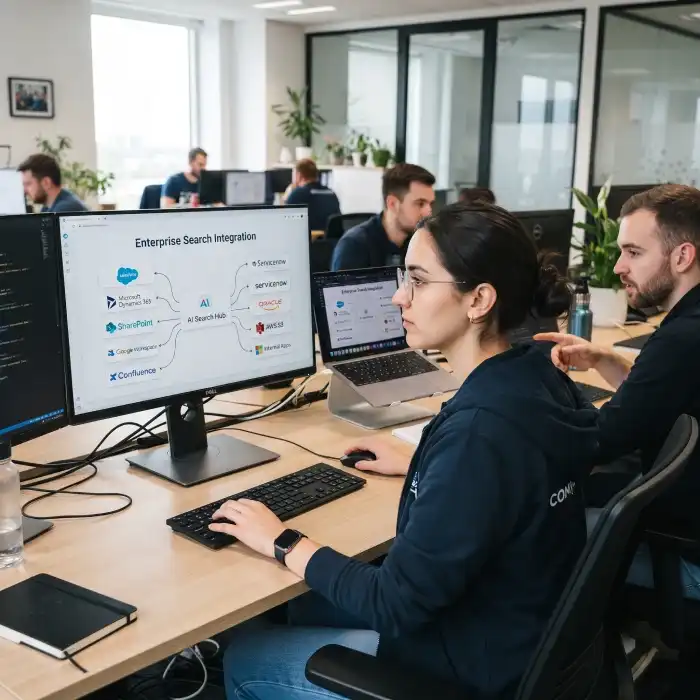
Create conversational search experiences where employees can ask questions instead of constructing complicated search queries.

Improve ranking and retrieval quality through: Metadata, Query understanding, Semantic relevance, Business rules, Feedback, Ranking optimization.

Track how users search and where search experiences can be improved.


Discover how enterprise AI search improves information discovery, connects business data, delivers relevant results, enhances productivity, and helps teams make faster decisions.
Help employees find relevant information without searching through multiple systems manually.
Reduce time spent locating documents, knowledge, and business information.
Make organizational knowledge easier to discover across departments.
Let employees ask questions in everyday language.
Combine semantic understanding, vector retrieval, keyword search, and ranking to improve search relevance.
Use RAG and Generative AI to turn retrieved information into contextual answers.
Connect information from multiple enterprise sources through a unified experience.
Turn scattered information into an accessible organizational knowledge layer.
Apply appropriate access controls so users receive information they are authorized to access.
Create an enterprise knowledge layer that can also support future AI assistants and agents.
We use LLMs, embedding models, vector databases, APIs, search engines, cloud platforms, and AI tools to build secure, scalable enterprise search solutions.












































Our structured process builds intelligent enterprise search solutions through data analysis, indexing, AI integration, testing, deployment, and continuous optimization.
Understand your business, users, information sources, search challenges, and AI objectives.
Identify the systems and repositories that should be included in enterprise search.
Design the search, indexing, retrieval, AI, security, and integration architecture.
Connect and ingest information from approved sources.
Clean, normalize, chunk, enrich, classify, and prepare content for retrieval.
Create appropriate keyword, semantic, vector, or hybrid indexes.
Connect retrieval with LLMs to generate contextual answers.
Apply authentication, authorization, access control, and permission-aware retrieval.
Build a user-friendly search interface with: Search bar, Natural-language queries, Filters, Suggestions, Source citations, Conversational follow-ups.
Test: Search relevance, Retrieval accuracy, AI responses, Security, Performance, Scalability.
Deploy in your preferred cloud or enterprise environment.
Use analytics and feedback to continuously improve search relevance and AI response quality.

Discover how enterprise AI search helps businesses across industries improve knowledge discovery, connect information, support employees, and deliver faster, more relevant results.
Use cases: Healthcare knowledge assistant, Policy search, Document discovery, Internal knowledge search, AI-powered information retrieval
Use cases: Research search, Compliance knowledge, Internal policy search, Financial document discovery, Employee knowledge assistant
Search and retrieve information from policies, documents, claims-related information, and internal knowledge repositories.
Help teams discover: Product documentation, Technical manuals, Maintenance knowledge, SOPs, Internal policies, Engineering information
Use AI search for: Product discovery, Product knowledge, Customer support, Internal documentation, Catalog search
Create AI-powered search across: Course materials, Research, Institutional policies, Knowledge bases, Educational content
Search across: Operational documentation, Shipment information, SOPs, Logistics knowledge, Customer support information
Create internal AI search across: Product documentation, Engineering knowledge, Jira, Confluence, Code documentation, Customer information
Search: Property information, Contracts, Market reports, Internal documents, Customer information
Help consultants and professional teams discover: Research, Client documents, Knowledge bases, Project information, Industry insights
Partner with Variance Infotech to build secure, scalable enterprise AI search solutions that connect business data, improve knowledge discovery, and deliver relevant results.
We combine AI, search technology, data engineering, LLMs, RAG, and application development.
We design the search experience around your organization instead of forcing your business into a one-size-fits-all solution.
Connect information across enterprise applications, databases, documents, and cloud platforms.
Build AI-powered search experiences that can retrieve enterprise context before generating answers.
Enterprise search must protect business information. Access controls and permissions should be incorporated into the architecture rather than treated as an afterthought.
Design systems that can grow as your data, users, applications, and AI use cases expand.
We focus on making search simple for the people actually using it.
We focus on measurable outcomes such as productivity, knowledge discovery, search relevance, and operational efficiency.
From strategy and architecture to development, integration, deployment, and optimization.
Find answers to common questions about enterprise AI search, including implementation, data integration, security, scalability, search accuracy, and business use cases.
Enterprise AI Search is an intelligent search solution that helps organizations find and understand information across internal business data sources using technologies such as AI, semantic search, vector search, natural-language processing, and Generative AI.
Traditional enterprise search often focuses on matching and ranking documents against keywords. AI-powered enterprise search can additionally understand natural-language intent, use semantic/vector retrieval, combine multiple search methods, and generate contextual answers using retrieved information.
Depending on the architecture, enterprise AI search can connect with documents, databases, CRM systems, knowledge bases, cloud storage, intranets, SaaS applications, APIs, and other enterprise repositories.
Yes. Documents can be processed, indexed, and made searchable. AI-powered document retrieval can also identify relevant passages rather than relying only on document-level keyword matches.
RAG, or Retrieval-Augmented Generation, retrieves relevant information from an organization's data sources and provides that context to an LLM to generate a more grounded response.
Yes. Users can ask questions conversationally rather than relying only on exact keywords.
Yes. Permission-aware retrieval and access control can be incorporated into the architecture so users only receive information they are authorized to access. Enterprise platforms increasingly emphasize permission-aware enterprise search.
Yes. CRM systems can be integrated through APIs, connectors, or appropriate data pipelines.
Yes. One of the main purposes of enterprise search is to provide discovery across disparate organizational repositories rather than forcing users to search each repository separately.
Yes. Variance Infotech can develop custom AI search applications based on your data sources, users, security requirements, search experience, integrations, and business objectives.







Our sales manager reaches out to you within a few days after analyzing your business requirements.
Meanwhile, we sign an NDA to ensure the highest level of privacy.
Our pre-sale manager presents project estimates and an approximate timeline.