AI Consulting Services
 RAG Development
 LLM Development
 AI App Development
 AI Software Development
 AI Integration Services
 AI Agent Development
 AI Chatbot Development
 LLM Fine-Tuning
 Generative AI Integration
 AI Copilot Development
 Data Analytics
 Data Warehousing
 Data Annotation
 AIOps
AIOps
 DevOps Consulting
 DevOps Automation
 SRE
SRE
 LLM Observability
 AI for Healthcare
 AI for CRM
 AI for Customer Support
 AI for Manufacturing
 AI for Real Estate
 AI for Education
 AI for Finance
 AI for E-Commerce
 AI/ML Consulting
 Object Detection
 ChatBot Development
 Computer Vision
 Natural Language Processing
 Data and Ai
 Mobile Apps Development
 Chrome Extension Development
 Salesforce Consulting
 Salesforce Product
 Salesforce Case Study
 SuiteCRM Consulting
 SuiteCRM Addons
 Devops
 AWS Consulting
 Digital Ocean Consulting
 OnPrem. Server Support
 Cloud Migration Services
 Salesforce WhatsApp Business API
 Salesforce WhatsApp Web Integration
 Salesforce Telephony Integration
 Dentrix To GHL
 Outlook Integration
 MindBody Integration
 Zillow Integration
 Open Dental To GHL
 Number Plate Recognition
 Taxi App & Mobility
 Smart Bus & Fleet System
 HR Solutions (Salesforce)
 Quick HRMS (SuiteCRM)
 CRM For Telecom Industry
 CRM For Travel
 CRM For Call Center
 CRM For Education
 CRM For Healthcare
 CRM For Clinics
 CRM For Locksmith
 CRM For Law
 NodeJS
 Python
 .NET
.NET
 Classic ASP
 Core PHP
 ReactJS
 AngularJs
 Android
 iOS
iOS
 Flutter
 React Native
 AR/VR
AR/VR
 CodeIgniter
 Laravel
 Hire .NET Core Developer
 Hire Salesforce Developer
 CRM For Legal Practice
 Online Photo Booking System
 Task Scheduler for Construction Industry
 Patient Management Software
 Dentist Management System
 Food Delivery App
 CRM For Aviation Company
 Salesforce Marketing Cloud for Online Retail Store
 Salesforce Implementation & Customization For RFID Supplier
 Ecommerce System Integration With ERP
 CRM For Real Estate Company
 Find Nearby Salon
 Taxi Booking App
 CRM For Travel Agency
 Case Management Software
 Engineering Company Website
 CRM For Telecom Industry
 Company Profile
 SuiteCRM Profile
 Telco CRM white paper
 AI enabled speech analysis
Requirement Discovery
Understand your application, users, data, search behavior, and business objectives.
Pioneer in Offering CRM Solutions since 2010...
 ChatGPT Development
 Claude AI Development
 Gemini AI Development
 Microsoft Copilot Development
 DeepSeek AI Development
 LangChain Development
 CrewAI Development
 AutoGen Development
 LangGraph Development
 Pinecone Development
 Weaviate Development
 AI Workflow Automation
 Qdrant Development
 Cursor AI Consulting (Soon)
 GitHub Copilot Consulting (Soon)
 Enterprise AI Search (Soon)

Traditional databases are excellent at storing structured information. But modern AI applications often need to work with meaning, context, similarity, and unstructured information.
Users may ask questions using different words while looking for the same meaning.
Businesses often have thousands or millions of documents, records, product descriptions, or knowledge assets.
LLM applications perform better when the application can retrieve appropriate information before generating a response.
Documents, text, product information, knowledge bases, and other content need intelligent retrieval mechanisms.
Recommendation applications often need to identify items that are semantically or behaviorally similar.
As data and user requests increase, the retrieval layer needs to be designed for performance and scalability.
We follow a practical approach to build Qdrant solutions through data preparation, vector integration, AI development, testing, deployment, and continuous optimization.
We analyze your application, data, users, search requirements, and AI objectives.
We determine how embeddings, collections, metadata, indexes, retrieval, and application components should work together.
We help structure and prepare documents, text, product data, knowledge bases, or other content for vector-based retrieval.
Choose appropriate embedding models based on your data, language, domain, accuracy, and application requirements.
Integrate Qdrant with your AI application, backend, APIs, LLMs, and data pipelines.
Develop semantic search, similarity search, metadata filtering, RAG retrieval, or recommendation workflows.
Evaluate retrieval relevance, response quality, performance, scalability, and cost.
Continuously optimize your vector search architecture as your application and data evolve.
Apply appropriate access controls, data protection, and monitoring to keep vector search reliable and secure.
From initial architecture to production deployment, we provide end-to-end Qdrant development services for modern AI applications.
Build customized vector database solutions using Qdrant for
AI-powered applications.
Use cases include: Semantic search, Similarity
search, RAG, Recommendations, Knowledge retrieval, AI assistants.

Get expert guidance on designing a Qdrant architecture that fits
your AI application and data requirements.
We can help with:
Architecture planning, Data modeling, Embedding strategy, Search strategy, Performance
considerations, Integration planning.

Connect Qdrant with: LLM applications, AI chatbots, RAG pipelines, Backend applications, APIs, Data pipelines, Existing enterprise applications.

Build Retrieval-Augmented Generation applications using Qdrant as the vector retrieval layer.

Build search experiences that understand the meaning behind
queries instead of depending only on exact keyword matches.
Potential
applications: Enterprise search, Document search, Product search, Knowledge
search, Customer support search.

Build AI chatbots that use Qdrant to retrieve relevant
information from your organization's approved knowledge sources.
Potential
capabilities: Knowledge retrieval, Semantic search, RAG, Context-aware
responses, Document-based Q&A.

Use vector similarity to support recommendation
experiences.
Potential use cases: Product recommendations, Content
recommendations, Similar products, Similar documents, Personalized discovery.

Move existing vector search workloads to Qdrant where
appropriate.
Services may include: Architecture assessment, Data
migration planning, Embedding migration, Collection design, Integration updates, Testing.

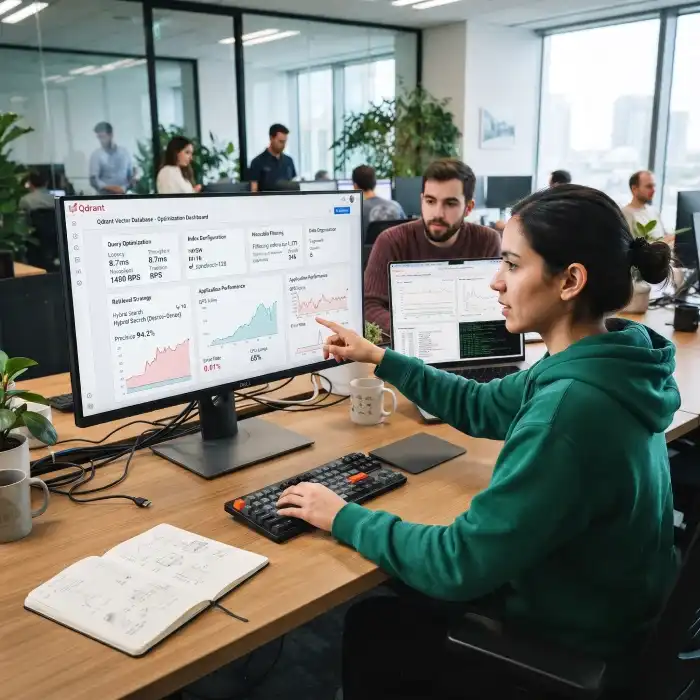
Improve your vector retrieval architecture through: Query optimization, Index configuration, Metadata filtering, Data organization, Retrieval strategy, Application architecture.
Connect Qdrant with application APIs and backend services to create production-ready AI workflows.

Implement retrieval strategies combining semantic/vector search with other search approaches where required by the application.

Create AI-ready enterprise knowledge bases that allow applications to retrieve relevant information from business content.

Connect Qdrant with AI agents that need access to persistent knowledge and semantic retrieval.

Support Qdrant deployment strategies based on application architecture, infrastructure, scalability, and operational requirements.


Discover how Qdrant development enables fast vector search, improves data retrieval, supports RAG applications, and helps businesses build scalable AI solutions.
Help applications find information based on meaning and similarity.
Retrieve relevant context for LLM and Generative AI applications.
Give AI applications access to relevant business knowledge.
Design vector retrieval architecture for growing datasets and applications.
Build retrieval layers that connect business information with LLM-powered applications.
Use vector similarity to identify related products, content, documents, or information.
Make large collections of unstructured information easier to search and explore.
Connect Qdrant with different embedding models, AI frameworks, applications, and data sources.
Deliver more relevant search results and AI-generated responses.
Create a retrieval foundation that can support future AI features and applications.
We use Qdrant, embedding models, LLMs, APIs, cloud platforms, and modern AI tools to build secure, scalable, and high-performance vector search solutions.




























Our structured process turns business requirements into reliable Qdrant solutions through planning, data preparation, vector integration, testing, deployment, and continuous optimization.
Understand your application, users, data, search behavior, and business objectives.
Design the vector database and AI retrieval architecture.
Prepare documents, content, metadata, and other data for vectorization.
Select and integrate appropriate embedding models.
Create collections and configure the vector retrieval layer based on application requirements.
Connect Qdrant with your application, RAG pipeline, chatbot, agent, or recommendation engine.
Evaluate: Search relevance, Retrieval quality, Latency, Scalability, Application behavior.
Deploy the solution in the appropriate cloud or infrastructure environment.
Continuously evaluate retrieval performance and optimize the AI application.

Discover how Qdrant helps businesses across industries improve vector search, enhance data retrieval, power RAG applications, and deliver smarter AI experiences.
Use Qdrant-powered retrieval for: Healthcare knowledge systems, Document search, AI assistants, RAG applications, Internal knowledge discovery
Potential applications: Financial knowledge search, Document retrieval, Customer support AI, RAG assistants, Research applications
Use cases include: Policy document search, Claims knowledge systems, Customer support assistants, Semantic document retrieval, AI knowledge bases
Potential applications: Technical document search, Equipment knowledge systems, Maintenance knowledge, AI assistants, Product information retrieval
Build: Product discovery, Semantic product search, Recommendation systems, Personalized discovery, AI shopping assistants
Use Qdrant for: Educational knowledge bases, AI tutors, Course content search, Document retrieval, Personalized learning applications
Potential use cases: Property search, Semantic property discovery, Document retrieval, AI property assistants, Recommendation systems
Build AI solutions for: Logistics knowledge search, Document retrieval, Operations assistants, Intelligent search, Knowledge management
Potential applications: Travel recommendation, Semantic destination search, AI travel assistants, Content discovery, Customer support
Use Qdrant for: Enterprise search, AI copilots, RAG, Developer assistants, AI agents, Product recommendations
Potential applications: Knowledge management, Research assistants, Document search, AI-powered discovery, Internal knowledge assistants
Partner with Variance Infotech to build scalable Qdrant solutions that optimize vector search, improve AI retrieval, and support reliable RAG applications.
We combine AI engineering with application development to build complete production-ready solutions.
Our AI capabilities span: LLM development, RAG, Generative AI, AI agents, AI chatbots, AI copilots.
From architecture and embeddings to integration, deployment, monitoring, and optimization.
We design Qdrant implementations around your actual business requirements rather than simply implementing a technology.
Every AI application has different data, retrieval, scalability, and performance requirements. We build architecture accordingly.
Connect Qdrant with existing applications, APIs, databases, AI models, and enterprise systems.
Design retrieval infrastructure that can evolve as your data and AI application grow.
Focus on retrieval quality, response time, application performance, and operational efficiency.
Build AI solutions across healthcare, finance, insurance, manufacturing, retail, education, logistics, real estate, technology, and professional services.
Find answers to common questions about Qdrant development, including vector search, RAG integration, implementation, scalability, data retrieval, and AI application use cases.
Qdrant is a vector search and similarity search engine designed to store and retrieve vector representations of information. It can be used as part of AI applications that require semantic or similarity-based retrieval.
Qdrant can be used for applications such as semantic search, similarity search, RAG, recommendation systems, knowledge retrieval, AI assistants, and other AI applications that require vector-based retrieval.
Qdrant development involves designing and implementing applications that use Qdrant for vector storage and retrieval, including data preparation, embeddings, collections, search, filtering, APIs, and integration with AI applications.
Qdrant can serve as the vector retrieval layer in a RAG architecture. It can store embeddings and retrieve relevant information that can then be provided to an LLM as context.
Yes. Qdrant can be integrated into LLM applications as part of a retrieval architecture. The exact implementation depends on the selected model, embedding strategy, application framework, and data architecture.
Yes. Qdrant can provide semantic retrieval for AI chatbots that need to access business documents, knowledge bases, product information, or other approved data sources.
Yes. Vector similarity can be used to identify similar products, documents, content, or other entities depending on how the application represents and retrieves data.
Migration may be possible depending on the source database, data structure, embedding models, metadata, and application architecture. We can assess the existing environment and design a migration approach.
Qdrant supports filtering capabilities that can be used alongside vector retrieval to narrow results according to application-specific metadata.
Yes. We can develop custom Qdrant-based applications for semantic search, RAG, recommendation systems, knowledge management, AI assistants, and other AI use cases.







Our sales manager reaches out to you within a few days after analyzing your business requirements.
Meanwhile, we sign an NDA to ensure the highest level of privacy.
Our pre-sale manager presents project estimates and an approximate timeline.