AI Consulting Services
 RAG Development
 LLM Development
 AI App Development
 AI Software Development
 AI Integration Services
 AI Agent Development
 AI Chatbot Development
 LLM Fine-Tuning
 Generative AI Integration
 AI Copilot Development
 Data Analytics
 Data Warehousing
 Data Annotation
 AIOps
AIOps
 DevOps Consulting
 DevOps Automation
 SRE
SRE
 LLM Observability
 AI for Healthcare
 AI for CRM
 AI for Customer Support
 AI for Manufacturing
 AI for Real Estate
 AI for Education
 AI for Finance
 AI for E-Commerce
 AI/ML Consulting
 Object Detection
 ChatBot Development
 Computer Vision
 Natural Language Processing
 Data and Ai
 Mobile Apps Development
 Chrome Extension Development
 Salesforce Consulting
 Salesforce Product
 Salesforce Case Study
 SuiteCRM Consulting
 SuiteCRM Addons
 Devops
 AWS Consulting
 Digital Ocean Consulting
 OnPrem. Server Support
 Cloud Migration Services
 Salesforce WhatsApp Business API
 Salesforce WhatsApp Web Integration
 Salesforce Telephony Integration
 Dentrix To GHL
 Outlook Integration
 MindBody Integration
 Zillow Integration
 Open Dental To GHL
 Number Plate Recognition
 Taxi App & Mobility
 Smart Bus & Fleet System
 HR Solutions (Salesforce)
 Quick HRMS (SuiteCRM)
 CRM For Telecom Industry
 CRM For Travel
 CRM For Call Center
 CRM For Education
 CRM For Healthcare
 CRM For Clinics
 CRM For Locksmith
 CRM For Law
 NodeJS
 Python
 .NET
.NET
 Classic ASP
 Core PHP
 ReactJS
 AngularJs
 Android
 iOS
iOS
 Flutter
 React Native
 AR/VR
AR/VR
 CodeIgniter
 Laravel
 Hire .NET Core Developer
 Hire Salesforce Developer
 CRM For Legal Practice
 Online Photo Booking System
 Task Scheduler for Construction Industry
 Patient Management Software
 Dentist Management System
 Food Delivery App
 CRM For Aviation Company
 Salesforce Marketing Cloud for Online Retail Store
 Salesforce Implementation & Customization For RFID Supplier
 Ecommerce System Integration With ERP
 CRM For Real Estate Company
 Find Nearby Salon
 Taxi Booking App
 CRM For Travel Agency
 Case Management Software
 Engineering Company Website
 CRM For Telecom Industry
 Company Profile
 SuiteCRM Profile
 Telco CRM white paper
 AI enabled speech analysis
AI Architecture Assessment
Understand your current LLM, RAG, agent, and application architecture.
Pioneer in Offering CRM Solutions since 2010...
 ChatGPT Development
 Claude AI Development
 Gemini AI Development
 Microsoft Copilot Development
 DeepSeek AI Development
 LangChain Development
 CrewAI Development
 AutoGen Development
 LangGraph Development
 Pinecone Development (Soon)
 Weaviate Development (Soon)
 AI Workflow Automation (Soon)
 Qdrant Development (Soon)
 Cursor AI Consulting (Soon)
 GitHub Copilot Consulting (Soon)
 Enterprise AI Search (Soon)

Traditional application monitoring can tell you that an API is slow or an application has failed. But LLM applications require deeper visibility into prompts, model responses, performance, costs, and quality.
Monitor token consumption and model usage to understand where your LLM budget is going.
Track end-to-end latency across models, retrieval systems, APIs, and tools.
Evaluate AI outputs and identify patterns that may impact response quality.
Trace prompts, model calls, retrieval steps, tools, and responses to understand what happened during an interaction.
Traditional monitoring doesn't provide enough context to understand LLM-specific behavior.
Monitor AI quality and user feedback to identify where your application needs improvement.
We make AI systems observable from the first user request to the final response.
We analyze your LLM models, applications, prompts, RAG pipelines, vector databases, APIs, agents, and external tools.
Identify the metrics that matter most to your business: Accuracy, Latency, Cost, Quality, Safety, Reliability, User satisfaction.
Implement structured tracing and monitoring across models, prompts, retrieval systems, tools, and application workflows.
Collect relevant metrics, logs, traces, prompts, responses, token usage, and performance information.
Measure response quality, relevance, groundedness, safety, and other business-specific evaluation criteria.
Detect performance problems, high costs, hallucination patterns, failed retrievals, and application errors.
Use observability insights to improve prompts, models, retrieval pipelines, infrastructure, and AI workflows.
Define standards for security, privacy, compliance, data protection, and responsible AI monitoring.
Track AI performance over time and continuously optimize models, prompts, retrieval, costs, and user experience.
From LLM tracing and prompt monitoring to AI quality evaluation and cost optimization, we provide end-to-end observability for production AI applications.
Monitor the health and performance of production LLM applications.
Track: Request volume, response time, errors, model performance, token usage, cost, and user feedback.

Trace every step of an AI request.
Track: User Request → Prompt → Retrieval → Model → Tool → Response.
This makes complex LLM workflows easier to understand and debug.

Monitor prompts and generated responses to identify unexpected outputs, prompt failures, response quality issues, prompt injection patterns, and inconsistent behavior.

Measure latency, throughput, error rates, model response time, retrieval latency, and API performance.

Track token consumption and model usage to help businesses understand and optimize LLM costs.
Monitor: Input tokens, output tokens, total tokens, cost per request, cost per user, cost by application, and cost by model.

Evaluate AI responses against business-specific criteria.
Possible evaluation dimensions: Relevance, accuracy, groundedness, coherence, completeness, safety, and user satisfaction.

Identify potentially unsupported or inaccurate AI responses and monitor hallucination patterns over time.

Monitor complete Retrieval-Augmented Generation workflows.
Track: User query, embedding generation, vector search, retrieved documents, context quality, prompt construction, and LLM response.

Monitor AI agents that interact with tools, APIs, databases, and external systems.
Track: Agent reasoning steps where appropriate, tool calls, API calls, execution time, failed actions, workflow completion, and cost.
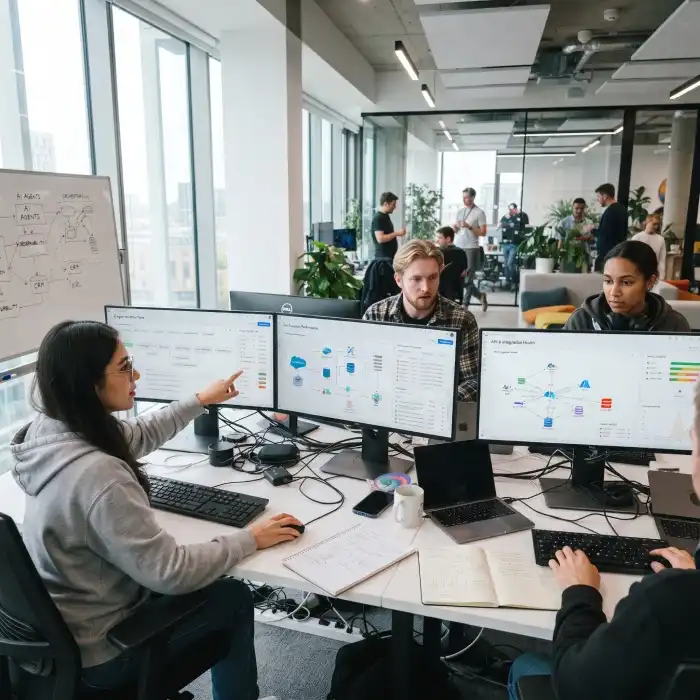
Identify API failures, timeout errors, rate limits, invalid responses, tool failures, retrieval errors, and application errors.
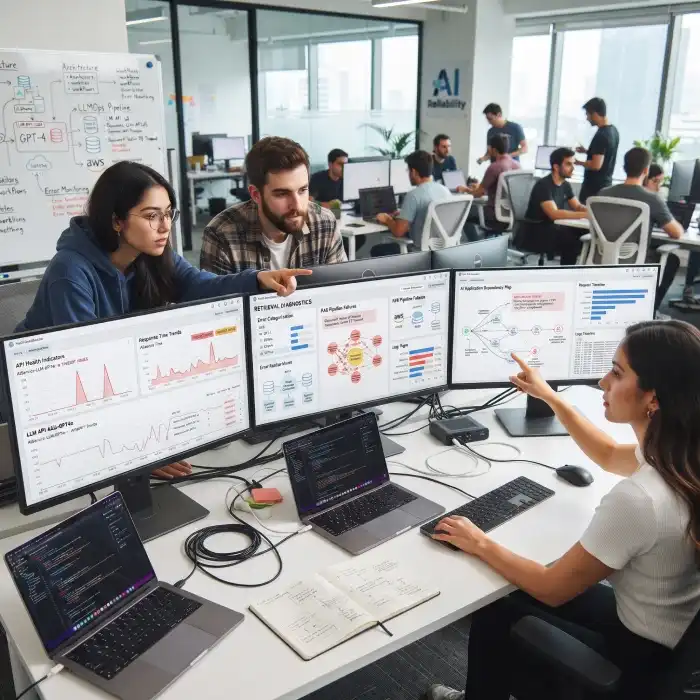
Create business-specific quality metrics and monitor AI performance continuously.

Use traces and contextual telemetry to investigate problematic AI interactions and identify the source of failures.

Use observability data to identify opportunities such as model selection, prompt optimization, token reduction, caching, routing, and request optimization.

Monitor AI applications for risks involving prompt injection, sensitive data exposure, unsafe outputs, unauthorized model usage, and policy violations.

Monitor applications using multiple models from providers such as OpenAI, Anthropic, Google Gemini, Meta Llama, Azure OpenAI, and open-source models.

Build observability systems tailored to your application's architecture, industry requirements, AI workflows, and business KPIs.

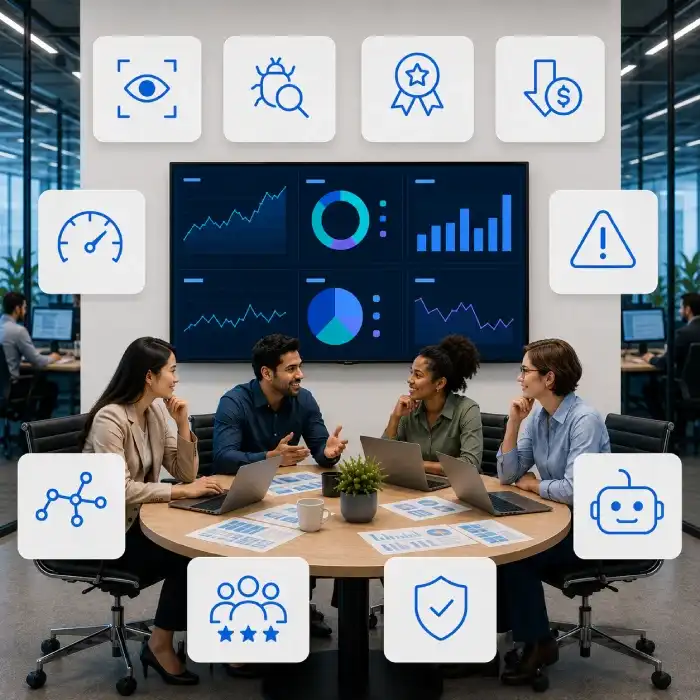
LLM observability helps monitor AI performance, improve response quality, reduce costs, and identify issues across your AI applications.
Understand what happens across every important stage of your LLM application.
Trace complex workflows and identify the source of errors faster.
Continuously evaluate and improve AI responses.
Monitor tokens and model usage to identify unnecessary spending.
Identify latency bottlenecks across models, APIs, retrieval systems, and infrastructure.
Monitor AI behavior and identify potential safety, security, and governance issues.
Understand whether your retrieval system is providing the right information to the model.
Monitor agent workflows, tool usage, and execution performance.
Use user feedback and AI quality metrics to continuously improve applications.
Move from experimental AI applications to measurable, observable, and manageable production systems.
We use modern observability platforms, monitoring tools, AI frameworks, and analytics technologies to track, evaluate, and optimize LLM performance.











































Our structured process helps monitor LLM performance through data collection, trace analysis, evaluation, monitoring, and continuous optimization.
Understand your current LLM, RAG, agent, and application architecture.
Define the telemetry, metrics, evaluations, and dashboards required.
Add appropriate tracing and monitoring across your AI workflows.
Capture relevant LLM, application, retrieval, performance, and cost metrics.
Create dashboards for engineering, AI, product, and business teams.
Implement automated and human evaluation workflows.
Configure alerts for performance, cost, quality, security, and reliability issues.
Use observability insights to improve models, prompts, RAG, infrastructure, and application performance.
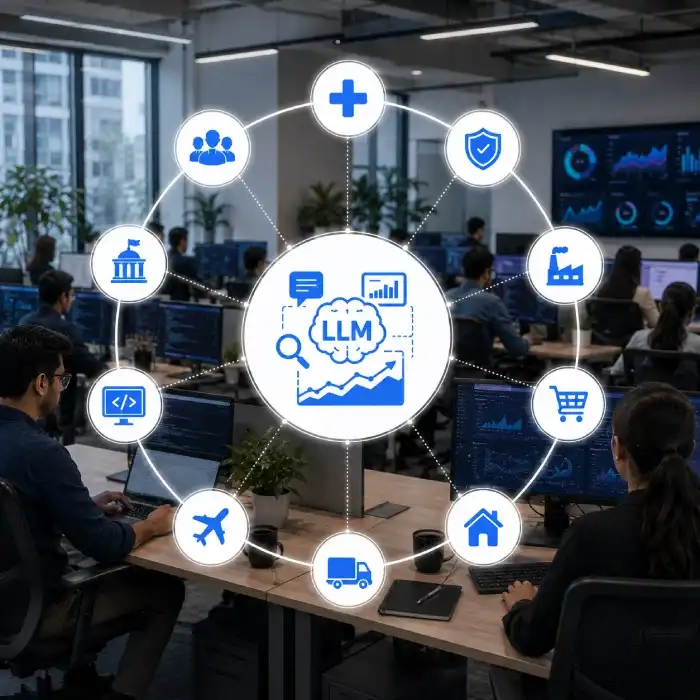
LLM observability helps businesses across industries monitor AI performance, improve response quality, manage costs, and build more reliable AI applications.
Monitor AI assistants, clinical knowledge applications, healthcare chatbots, and document intelligence workflows while supporting appropriate privacy and governance requirements.
Monitor AI-powered financial assistants, document analysis, customer service applications, and knowledge systems.
Track AI applications used for claims processing, policy analysis, customer support, and document intelligence.
Monitor AI copilots, maintenance assistants, knowledge systems, and industrial AI applications.
Track AI shopping assistants, recommendation experiences, customer service chatbots, and product search systems.
Monitor AI-powered property search, document analysis, customer assistants, and real estate knowledge platforms.
Observe AI tutors, learning assistants, knowledge systems, and educational chatbots.
Monitor AI assistants, document processing, customer service systems, and logistics optimization applications.
Track AI travel assistants, booking support, customer service chatbots, and recommendation applications.
Monitor enterprise copilots, AI agents, RAG applications, developer assistants, and AI-powered SaaS products.
Support monitoring and governance of AI-powered citizen services and knowledge applications.
Monitor AI applications used for research, document analysis, knowledge management, and customer support.
Choose Variance Infotech to gain clear visibility into your AI systems with expert observability, actionable insights, and scalable solutions that improve LLM performance and reliability.
Our AI capabilities extend across LLM development, RAG, AI agents, chatbots, AI integration, and Generative AI applications.
We combine AI development with modern DevOps, observability, automation, and AIOps practices.
We monitor the complete AI workflow—not just the LLM API call.
We help you measure the metrics that matter to your business, not just technical metrics.
Support applications using commercial APIs, cloud-hosted models, and open-source LLMs.
Monitor complex retrieval and agent workflows across models, tools, databases, and APIs.
Use telemetry and analytics to identify opportunities for better model and token efficiency.
Build monitoring around AI security, responsible AI, data protection, and enterprise governance requirements.
Observability is not a one-time project. We help teams continuously improve AI quality, performance, reliability, and cost.
Find answers to common questions about LLM observability, including monitoring, tracing, evaluation, performance, costs, and improving the reliability of AI applications.
LLM Observability is the practice of monitoring, tracing, evaluating, and analyzing Large Language Model applications to understand their performance, behavior, quality, cost, and reliability.
LLM applications behave differently from traditional software. Observability helps teams understand prompts, responses, token usage, latency, retrieval processes, model behavior, errors, and AI quality in production.
LLM monitoring focuses primarily on predefined metrics and alerts. LLM observability provides deeper context through traces, logs, evaluations, prompts, responses, and application workflows to help teams understand why something happened.
You can monitor latency, token usage, costs, errors, prompts, responses, model usage, retrieval performance, tool calls, user feedback, quality metrics, and other application-specific KPIs.
Yes. LLM observability can trace the complete RAG workflow, including queries, embeddings, vector search, retrieved documents, context, prompts, model responses, and application performance.
Yes. AI agent observability can track agent workflows, tool calls, API interactions, execution time, errors, costs, and workflow outcomes.
Yes. Visibility into token usage, model selection, request patterns, and application behavior can help identify opportunities to optimize LLM costs.
Observability can support hallucination detection and monitoring by using evaluation methods such as groundedness, factuality checks, human review, and automated evaluation workflows.
Observability solutions can support applications using providers such as OpenAI, Azure OpenAI, Anthropic, Google Gemini, Meta Llama, Hugging Face, and other model providers, depending on the application architecture.
Yes. LLM telemetry can be integrated with broader application observability and monitoring ecosystems using technologies such as OpenTelemetry and enterprise monitoring platforms.
Yes. We can design custom observability architectures based on your LLM, RAG, AI agent, cloud, application, security, and business requirements.







Our sales manager reaches out to you within a few days after analyzing your business requirements.
Meanwhile, we sign an NDA to ensure the highest level of privacy.
Our pre-sale manager presents project estimates and an approximate timeline.